UK Steel: Competitiveness scheme welcome, but electricity price crisis for steel deepens
UK Steel welcomes today’s publication of the Government’s response to the consultation on the British Industrial Competitiveness Scheme (BICS). The scheme will be very helpful for parts of the steel supply chain and energy‑intensive assets not currently covered by existing programmes. This is especially beneficial for companies previously ineligible for support, as it will materially reduce their electricity bills.
However, it will not reduce electricity prices for steelmakers themselves, who already receive similar support through the British Industry Supercharger. As a result, the scheme does not address the core competitiveness challenge now facing UK steel production itself. The Middle Eastern war has significantly worsened that problem, driving a sharp rise in wholesale electricity prices and dramatically widening the gap between UK producers and European competitors.
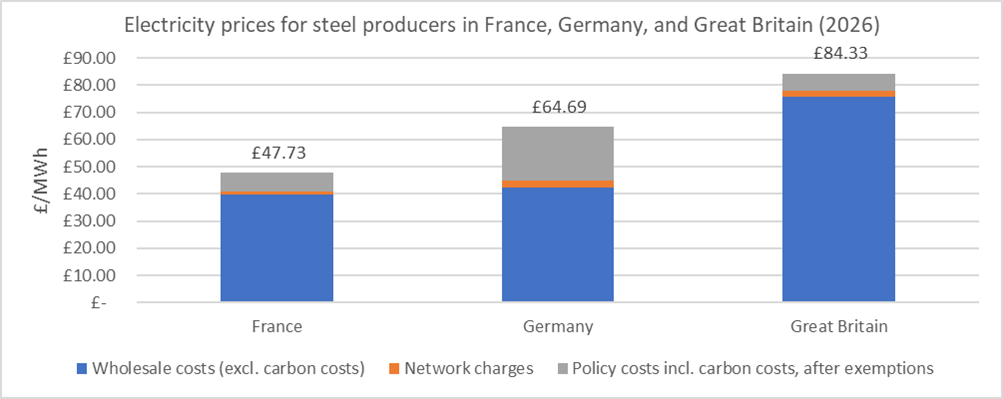
UK steelmakers are now paying up to 77% more for electricity than competitors in France and Germany (up from 25%), despite existing Government support, due to the Middle East war. Indicative 2026 industrial prices are estimated for the UK at ~£84/MWh, vs France at ~£48/MWh and Germany at ~£65/MWh. Without action, the UK steel industry will face an additional £82m annual electricity cost compared to if we were operating in France, potentially delaying decarbonisation and investments, leading to order book loss, and putting the Steel Strategy at risk.
UK Steel has called for additional, targeted measures to address wholesale electricity prices, including a wholesale price rebalancing mechanism, as set out by the respected consultancy, Baringa.
Frank Aaskov, Director, Energy and Climate Change Policy, UK Steel, said:
“The BICS will bring welcome relief for parts of the steel supply chain and manufacturers not currently covered by existing schemes and materially lower their energy bills.
“But it will not lower electricity prices for steel producers themselves, who remain exposed to exceptionally high wholesale power costs. That problem has intensified sharply in recent months. As a result of the Middle East war, UK steelmakers are now paying nearly 80% more for electricity than competitors in France and Germany, up from around 25% previously. This is happening despite the support already in place and reflects the UK’s continued exposure to gas‑driven electricity prices.
“To make the Steel Strategy a success and deliver the Government’s industrial and decarbonisation ambitions, additional measures are now essential. That means targeted action to bring wholesale electricity prices into line with our European competitors that gives industry the confidence to invest.”
ENDS.
Contact details: Jon Harrison, Regulatory Affairs Manager, UK Steel jharrison@makeuk.org, 07743829613
Notes to editors:
- The BICS will exempt eligible businesses from the levies funding Renewable Obligations, Feed-In Tariffs, and Capacity Market schemes. Most steelmakers are already exempt from these levies under the British Industry Supercharger scheme, so the BICS will not provide additional benefits. However, the wider steel supply chain and some energy‑intensive assets are not eligible for the Supercharger scheme, where the BICS will be very welcome.
- High industrial electricity prices have hindered the UK steel industry's global competitiveness and slowed electrification efforts. Indicative 2026 industrial prices: UK ~£84/MWh vs France ~£48/MWh and Germany ~£65/MWh, as a result of the Middle East war, which has driven up UK industrial electricity prices more than in other countries due to reliance on gas for power generation.
- Government has already taken significant steps to strengthen competitiveness through the Steel Strategy’s tougher stance on trade, higher network charge compensation, and improved procurement policies, but the Middle East-driven spike in wholesale electricity prices is now creating renewed, exceptional pressure.
- Without action, the UK steel industry will face an additional £82m annual electricity cost compared to if we were operating in France, potentially delaying decarbonisation and investments, leading to order book loss, and putting the Steel Strategy at risk.
- UK Steel recommends that the Government introduce a wholesale price rebalancing mechanism for industrial electricity (steel and other exposed EIIs), where industrial power prices are fixed to strike prices benchmarked to European competitors. This targeted electricity price intervention for steel is fast, focused, compatible with net zero, and aligns with the Government's objectives of growth and Net Zero. Separately, it should also reintroduce a temporary, targeted Energy Bill Discount Scheme to compensate eligible businesses for energy costs, with special provisions for energy- and trade-intensive industries, until the wholesale mechanism is in place.
- The primary driver of the price disparity is now wholesale electricity costs, which are largely driven by the UK’s reliance on natural gas for power generation.
- Steel production is incredibly electro-intensive, and power costs can represent up to 180% of steel producers’ Gross Value Added (GVA) in the UK. With a switch to electric arc furnaces, the sector’s electricity consumption is expected roughly to double.
- Currently, the UK steel industry’s electricity use is equivalent to that of 800,000 homes, and an electric arc furnace uses approximately 0.5 MWh of electricity per tonne of steel.
- The Labour Government stated in its manifesto that “British industry is also held back by high electricity costs, which has often made investing here uncompetitive. Labour’s clean energy mission will drive down those bills, making British businesses internationally competitive [...]”.
About UK Steel: UK Steel is the trade association for the UK steel industry. It represents all the country’s steelmakers and most downstream steel processors.